Ryan P6 Services
Pty Ltd ABN: 83 157 924
224

Risk Analysis
All projects carry their own risks, generic
and environmental. Our risk management philosophy presents a proactive view of
project risk; it is an integral tool in managing projects and business
generally. Ryan P6 Services can offer the client strategic and tactical risk
management applications - either as part of a broader project management
consultancy or as a stand-alone service. We believe a managed risk culture is a
key ingredient to project success. We embrace the philosophy that risk
management is a fluid process, requiring flexibility and strategic thinking.
Risk is inevitable in a business organization
when undertaking projects. However, the project manager needs to ensure that risks
are kept to a minimal. Risks can be mainly divided between two types, negative
impact risk and positive impact risk. Not all the time would project managers
be facing negative impact risks as there are positive impact risks too. Once the risk has been identified, project managers
need to come up with a mitigation plan or any other solution to counter attack
the risk.
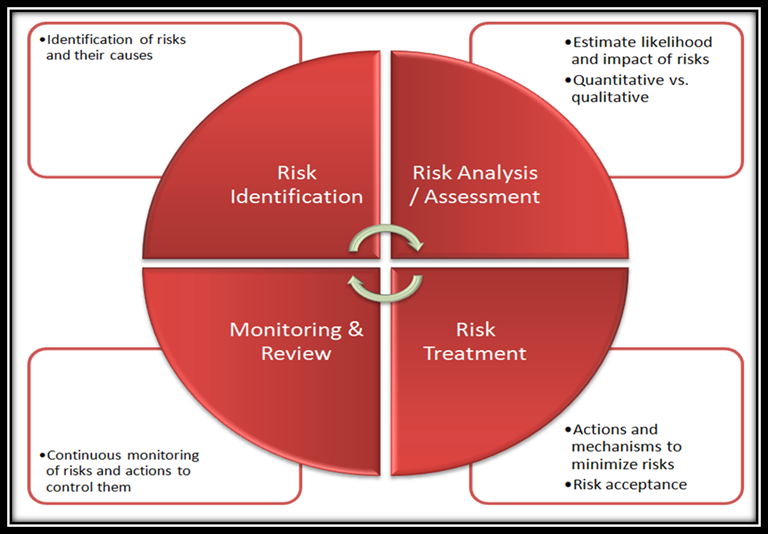
We can plan strategy based on four steps of
risk management which prevails in an organization. Let's go through each of the
step in project risk management:
Risk Identification
Managers face many difficulties when it comes
to identifying and naming the risks that occur when undertaking projects. These
risks could be resolved through structured or unstructured brainstorming or
strategies. It's important to understand that risks pertaining to the project
can only be handled by the project manager and other stakeholders of the
project.
Risks, such as operational or business risks
will be handled by the relevant teams. The risks that often impact a project
are supplier risk, resource risk and budget risk. Supplier risk would refer to
risks that can occur in case the supplier is not meeting the timeline to supply
the resources required.
Resource risk occurs when the human resource
used in the project is not enough or not skilled enough. Budget risk would
refer to risks that can occur if the costs are more than what was budgeted.
Risk Quantification
Risks can be evaluated based on quantity. We
analyze the likely chances of a risk occurring with the help of a matrix.
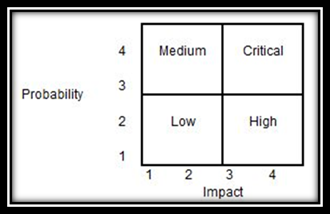
Using the matrix, the project manager can categorize
the risk into four categories as Low, Medium, High and Critical. The
probability of occurrence and the impact on the project are the two parameters
used for placing the risk in the matrix categories. As an example, if a risk
occurrence is low (probability = 2) and it has the highest impact (impact = 4),
the risk can be categorized as 'High'.
Risk Response
When it comes to risk management, it depends
on the project manager to choose strategies that will reduce the risk to
minimal. We always choose four risk response strategies, which are outlined
below.
1. Risks
can be avoided
2. Pass
on the risk
3. Take
corrective measures to reduce the impact of risks
4. Acknowledge
the risk
Risk Monitoring and Control:
Risks can be monitored on a continuous basis to
check if any change is made. New risks can be identified through the constant
monitoring and assessing mechanisms. Following are the considerations when it
comes to risk management process:
Each person involved in the process of
planning needs to identify and understand the risks pertaining to the project.
Once the team members have given their list
of risks, the risks should be consolidated to a single list in order to remove
the duplications.
Assessing the probability and impact of the
risks involved with the help of a matrix.
Split the team into subgroups where each
group will identify the triggers that lead to project risks.
The teams need to come up with a contingency
plan whereby to strategically eliminate the risks involved or identified.
Plan the risk management process. Each person
involved in the project is assigned a risk in which he/she looks out for any
triggers and then finds a suitable solution for it.
Risk Register
Often project managers will compile a
document, which outlines the risks involved and the strategies in place. This
document is vital as it provides a huge deal of information.
Risk register will often consists
of diagrams to aid the reader as to the types of risks that are dealt by the
organization and the course of action taken. The risk register should be freely
accessible for all the members of the project team.
Project Risk - an Opportunity or a Threat?
As mentioned above, risks contain two sides.
It can be either viewed as a negative element or a positive element. Negative
risks can be detrimental factors that can haphazard situations for a project.
Therefore, these should be curbed once identified. On the other hand, positive
risks can bring about acknowledgements from both the customer and the
management. All the risks need to be addressed by the project manager.
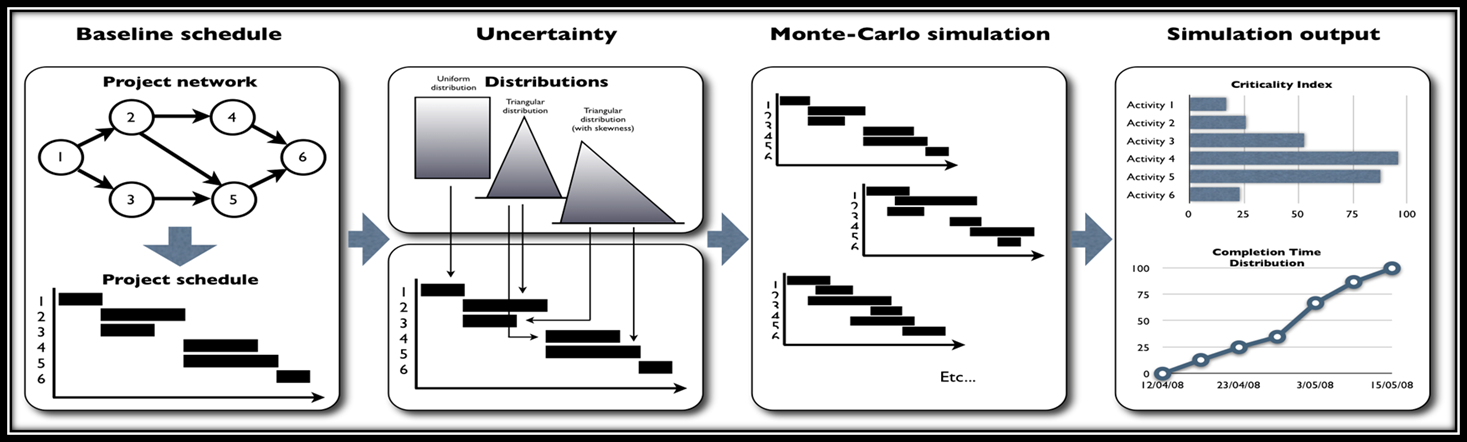
Monte Carlo Analysis
Ryan P6 Services complete risk analysis
through Monte Carlo software. Monte Carlo Analysis refers to a technique in
project management where a manager computes and calculates the total project cost
and the project schedule many times. This is
done using a set of input values that have been selected after careful
deliberation of probability distributions or potential costs or potential
durations. The Monte Carlo Analysis is important in project management
as it allows a project manager to calculate a probable total cost of a project
as well as to find a range or a potential date of completion for the project.
Since a Monte Carlo Analysis uses quantified data, this allows project managers
to better communicate with senior management, especially when the latter is
pushing for impractical project completion dates or unrealistic project costs.
Also, this type of an analysis allows the project managers to quantify perils
and ambiguities in project schedules.
A Simple Example of the Monte Carlo Analysis
A
project manager creates three estimates for the duration of the project: one
being the most likely duration, one the worst case scenario and the other being
the best case scenario. For each estimate, the project manager consigns the
probability of occurrence. The project is one that involves three tasks:
The first task is likely to take three days
(70% probability), but it can also be completed in two days or even four days.
The probability of it taking two days to complete is 10% and the probability of
it taking four days to finish is 20%.
The second task has a 60% probability of
taking six days to finish, a 20% probability each of being completed in five
days or eight days.
The final task has an 80% probability of
being completed in four days, 5% probability of being completed in three days
and a 15% probability of being completed in five days.
Using
the Monte Carlo Analysis, a series of simulations are done on the project
probabilities. The simulation is to run for a thousand odd times, and for each
simulation, an end date is noted. Once
the Monte Carlo Analysis is completed, there would be no single project
completion date. Instead the project manager has a probability curve depicting
the likely dates of completion and the probability of attaining each. Using
this probability curve, the project manager informs the senior management of
the expected date of completion. The project manager would choose the date with
a 90% chance of attaining it. Therefore, it could be said that using the Monte
Carlo Analysis, the project has a 90% chance of being completed in X number of
days.
Similarly, a project manager can adjudge the
estimated budget for a project using probabilities to simulate different end
results and in turn use the findings in a probability curve.
How is the Monte Carlo Analysis Carried Out?
The above example was one that contained a
mere three tasks. In reality, such projects contain hundreds if not thousands
of tasks. Using the Monte Carlo Analysis, a project manager is able to derive a
probability curve to show the ambiguity surrounding the duration and the costs
surrounding these hundreds or thousands of tasks. Conducting simulations
involving hundreds or thousands of tasks is a tedious job to be done manually.
Today there is project management scheduling software that can conduct
thousands of simulations and offer the project manager different end results in
a probability curve.
The Different Types of Probability
Distributions/Curves
A Monte Carlo Analysis shows the risk
analysis involved in a project through a probability distribution that is a
model of possible values. Some of the
commonly used probability distributions or curves for Monte Carlo Analysis
include:
The Normal or Bell Curve: In this type of
probability curve, the values in the middle are the likeliest to occur.
The Lognormal Curve: Here values are skewed.
A Monte Carlo Analysis gives this type of probability distribution for project
management in the real estate industry or oil industry.
The Uniform Curve: All instances have an
equal chance of occurring. This type of probability distribution is common with
manufacturing costs and future sales revenues for a new product.
The Triangular Curve: The project manager
enters the minimum, maximum or most likely values. The probability curve, a
triangular one, will display values around the most likely option.